Google
 

Tuesday, August 3, 2010

Sipadan Island, Sabah, Malaysia


Pulau Sipadan is an oceanic island near Semporna, a city on the east coast of Sabah, Malaysia. Pulau Sipadan is the only island in the Malaysian maritime limestone with the height of 600 meters above the water. Pulau Sipadan is known as a preferred place for scuba diving (scuba diving) are among the best in the world. According to poll results released by the organization's general election only seven wonders of the world's best (New 7 Wonders of Nature votes Committee), Sipadan Island has been listed among 77 of the earth and the world's best magic in the year ending July 2009.

The late Jacques Cousteau a marine researcher at the world famous island of Sipadan describes as 'the great art that does not diusik man', while divers around the world have chosen this island as one of five diving destinations in the world.

Sipadan Island has a relatively small size of an area of 12 hectares and is the only island in the Malaysian sea. Visitors can walk around the island at the time of 25 minutes. It is located about 700 meters above the sea bed and attracting diverse marine life that comes from the sea bed. Surrounded by the sea water is clean and clear with an amazing wealth of marine life.

Thick forest on the island to accommodate a large number of species of tropical birds including sea eagles, eagles, 'Sunbird', 'Starling' and wood pigeon, and was declared a bird sanctuary in 1933 by the colonial government of North Borneo and re-enacted in 1963 by The Government of Malaysia. Crustaceans, exotic wildlife, including coconut crabs scattered on the beach and hiding in crevices, crevice plants here.

As a diver, scuba divers have the chance encounters with turtles, resident schools of jacks, 'bumphead parrotfish and barracudas are commonly found in waters around the coral island.

History
The island was jointly claimed by Malaysia and Indonesia. The issue was brought to the Court of Justice. With the completion of evidence to support the Malaysian and British, International Court of Justice handed to the Malaysian island of Sipadan with Ligitan in 2003. The decision was based on "effective control" (effective occupation) as shown by the British (former pengkoloni Malaysia earlier), and the lack of a better claim. Government of Indonesia to comment feel very disappointed in the decision.

Attractions
Environmental underwater divers to Sipadan offers views full of marine life such as Barracuda, turtles, fish and so on. The colors are many and interchange, the marginal, rift, rock rungkupan, cavern and the vertical cerombong underwater reef formed by a variety of waiting to be witnessed by the divers who wish to enjoy a fun diving places in the world.
The island was established as a wildlife refuge in 1933 and surrounding the original has been maintained to date.

TIPS
Try to go diving in the early morning to dive the famous Sipadan - Barracuda Point. You have the opportunity to swim near a group of barracudas large numbers in the early morning hours.
TRANSPORTATION
By Sea
The nearest road to go to Pulau Sipadan is through Kota Kinabalu or Tawau.

Air Road
The nearest road to go to Pulau Sipadan is through Kota Kinabalu or Tawau.

Road
Continue your journey for an hour to reach the town of Semporna.

Who to contact
For more information, please contact Sabah Tourism Office Tel: +6088-248 698 / 211 732

Lodging
In view of Pulau Sipadan has been declared as protected areas so that the nearest lodging is located in the nearby islands like Mabul Island and Kapalai Island.


Enhanced by Zemanta

Tuesday, November 17, 2009

Lata Belatan Waterfall


Lata Belatan Waterfall

LATA BELATAN located in the Gunung Tebu Reserverd Forest the North Terengganu Forest Administration .Its cover an area of 20 hectares and is located approximately 15 kilometers south of the Jerteh City or 103 kilometers from the city of Kuala Terengganu.

For the purposes of natural beauty, the whole area in kompatmen 49 and 50 with an area of approximately 403 hectares of forest covering this soap opera has been maintained. Forest soap opera has developed in stages since 1985.

Forest consolation Lata Belatan consists of natural forest types of forest Low Diptercorp. It is rich with trees like Meranti and type Diptercarp Keruing more than 50% of forest composition. The types of non Diptercorp here that there is Nyatoh, Kelat, Mersawa, Rengas, dulcis and others.

Hilly areas, while high toward the summit of Gunung Tebu, consists of Meranti, Balau Red Sea. Area-slope of the steep hillside of the types commonly found here are Meranti Seraya, Meranti Keruing mixture of conifers and also a little like farmacia Oil and Damar.

Forest Recreational Development Lata Belatan is based on sustainable management where development is undertaken harmony with the environment. The concept of development which is compatible with the "Forest Camping Holiday".

In order to maintain the natural beauty and purity of water flow, 49 and 50 with an area of 403 hectares has remained under the classification of Forest Recreation.

Among the activities that can be done here while the rest enjoy the beauty of nature, picnic alone, with family or group, camping and cross-forest (jungle tracking).

For those who want to feel the atmosphere of challenge and adventure forest is more meaningful, may climb to the summit of Mount Cane with a height of 1.097 meters above sea level. The climb takes approximately 5 hours to reach kepuncaknya. Cold-weather environment with plants of various mountains and scenery that adds to the uniqueness interesting area.

The facilities provided here are food stalls, public toilets, prayer, rest huts, suspension bridge, guard huts and camping.
Reblog this post [with Zemanta]

Monday, November 16, 2009

Diving at Perhentian Island


Diving at Perhentian Island

Scuba Diving is one of the most important activities in Pulau Perhentian. Because this activity so popular among tourists, you will find many places that offer dive package price is very reasonable once. Places these so popular because you can dive on the level of the surface of the sea and the clear water makes crystallizes with divers can see so clearly in the sights while in the water. So exciting!

You also have the opportunity to see a closer-range marine life including turtles, sharks and other species are also jellyfish. Among which is the main attraction is the coral reef divers, however you must be careful not to approach when wildlife damage fragile ecosystem that is very simple.

Apart from marine life and coral reefs, you can also explore the Sugar Wreck, a big wreck - one time the ship carrying sugar - and also the Temple of the Sea of something shaped as if a landmark policy that emerged from the sea . You also have the option of visiting other Pulau Redang or Pulau Lang Tengah nearby - which is more hotspot places for diving.

If you do not want to do scuba diving activities, you can also try snorkeling activities in Perhentian Besar (the largest island between the two islands). There are several places of interest and good for activities such as snorkeling Gulf Pauh, Shark Point and Tanjung Besi. For those who interested in kayaking activities, it can be found at several resorts in the islands.
Reblog this post [with Zemanta]

Tuesday, June 30, 2009

Kuala Terengganu, Terengganu, Malaysia


General Informations:

Kuala Terengganu is one the district in the Terengganu, Malaysia. It's also Terengganu Capital. Other than that Kuala Terengganu is a Royal City because its located many Terengganu Malay Kingdom Palace.

History shown that Terengganu and Kuala Terengganu has been known hundreds of years ago. In Chinese history books such as “Ling-Wai-Tai-ta” written by Cao-Cu-Fei in 1178 mentioned ‘Teng-ya-nu’ and the book ‘Cu-fan-cih’ written by Cao-Ju-Kua in 1226 mentioned ‘Teng-ya-nung’. Both mentioned names referred to the Terengganu which was said to be ruled by Seri Wijaya Government (San-fo-Cih) in the 2nd Century. Ptolemy, a Greek astronomer, has noted down two ports in the east coast of Malay Land Peninsular. The ports are Primula and Kole. Primula is believed to be in Kuala Terengganu while Kole in Kemaman.

Today Kuala Terengganu known as Heritage Inshore Water City. Because its being develop so much by earlier Terengganu Chief Minister Datuk Seri Idris Jusoh. Now in Kuala Terengganu we can see many its change compared to past.

Getting To Kuala Terengganu:

By Flight:
Malaysia Airlines and Air Asia offer daily flight services to Kuala Terengganu from Kuala Lumpur International Airports (KLIA) to the Sultan Mahmud International Airport in Kuala Terengganu and its takes times around 45 minutes.

Firefly Airlines also offer flights to Kuala Terengganu form Subang Airport to The Sultan Mahmud International Airport in Kuala Terengganu. The Fares its so cheap compared to others.

Berjaya Air was offer the flight to Redang Island from Subang Jaya Airport and it's takes time around one hours. Besides that, it's also offered flight services from Seletar Airport, Singapore to Redang Island, it's takes time arround one hours.

By Bus:
From Kuala Lumpur it's takes times 7-8 hours depending on the bus route.
From Singapore it's takes times around 9.5 - 10 hours depending on the bus route.
From Johor Bharu, it's takes times around 10-11 hours depending on the bus route.
From Penang, it's takes time arroud 9 hours depending on the bus route.

By Car:
From Kuala Lumpur to Kuala Terengganu (455 KM)
From Singapura/Johor Bharu to Kuala Terengganu (562 KM)
From Penang to Kuala Terengganu (460 KM)

Place of Interest in Kuala Terengganu:

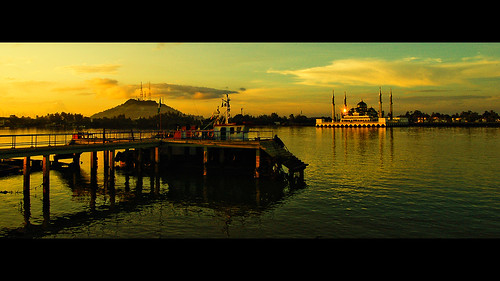
Tengku Tengah Zaharah Floating Mosque / Kuala Terengganu Floating Mosque

Located at Kuala Ibai, Kuala Terengganu. This Mosque was build above the lake. It's Also was a Icons Building of Terengganu.


Kuala Terengganu Islamic Civilization Park

This is the new Attractions place in Kuala Terengganu. Has a Crystal Mosque for tourist use and Replica Mosque from around the world.

Kuala Terengganu Heritage Bazaar

In Kuala Terengganu Heritage Bazaar you can come to buy some heritage items that you want and the cost was low compared to others places.

Batu Burok Beach
Batu Burok Beach is the popular beach in Kuala Terengganu and also in Terengganu. It's offer beiatifull view with the best place if you want to take rest a while.

Duyong Island / Pulau Duyong

Duyong Island is one of the interesting place in Kuala Terengganu. In here you can see how the boat was being make by the traditional boat maker and so many attractions you can see in Duyong Island.
Reblog this post [with Zemanta]

Saturday, April 25, 2009

La Hot Spring (Kolam Air Panas La)

Situated 140km north of Kuala Terengganu, the La Hot Spring water contains natural sulphur which is said to have healing properties. Visitors flock to this spring especially if they are afflicted with skin ailments.

There is more than just healing waters at the La Hot Springs in Terengganu. Located in Kampung La, at the foot of Gunung Tebu complex, La Hot Springs is the gateway to the Gunung Tebu Forest Reserve which is popular with adventurers who come to seek various tropical flora and fauna or to explore rock tunnels, streams and rivers.

The warm waters of the hot springs that run along a stream are very inviting. Many come to take a dip in the waters which can reputedly cure various ailments such as skin diseases and muscle pain.

The more adventurous go abseiling, trek along jungle paths and go caving. Fishing in the river and camping are popular activities.

The rocks are one of the attractions. Under a 20-metre high rock called Batu Bahtera (Ship Rock) is a 15m “secret” passage. Crawl under the rock and you’ll get to the other side. Continue walking another 20 minutes and you’ll come to Sungai Misteri. The river is thus named as it disappears into a large hole near Sungai Ping.

Nearby is a scenic spot, Lata Berangin, where water falls majestically down a 50-metre rocky surface into a pond. Other places of interest include Batu Katak (Frog Rock), Gua Kelawar and Kolam Puteri.

How To Get There?

To get to Kampung La, drive to Jertih, about 100 Km from Kuala Terengganu. From Jertih, drive about 30 KM towards Kampung La. The hot springs is 9kms from the village.

Where To Stay:

  • La Hot Spring Recreational Park Chalets
  • D’ Pinggiran Gunung Tebu Resort
  • Primula Coral View
  • Bukit Keluang Beach Resort
  • Taman Azimos Chalet
Where To Eat:

  • Local Food Stall

  • Mastura Jabi Satay
  • Sun Tee Restaurant
  • Gemilang Restaurant
  • Sakura Restaurant
  • Kedai Makan Mak Nah Kota Putra Public Market
  • Anjung Bahtera Restaurant, Mas Sekupang


Reblog this post [with Zemanta]

Thursday, October 9, 2008

Rhu Hentian Island (Pulau Rhu Hentian)


Perhaps Perhentian Island, Redang Island and some other pulau are too famous and ‘over heated’ to many people, Rhu Hentian Island which is only 15 nautical miles from offshore Kuala Besut is not known to most people. It is indeed a new discovered and developing island in the tourism industry in East Coast.

Because it is so close to the mainland, Rhu Hentian Island is accessible through Kuala Besut 20 to 30 minutes by boat. The island is not resident at the moment. This no doubt is an added value advantage for holiday seekers. The ecology system on the island and the marine life remain unspoiled due to this reason

How to get there?

To go to Kuala Besut Jetty:
To get to Kuala Besut, you can arrive in Kelantan or Kuala Terengganu. If you come from Kuala Terengganu, take a bus or taxi to Jerteh then another to Kuala Besut, or a direct bus to Kuala Besut. The journey will take nearly one and half hour.
Alternately you can choose to start from Kota Bharu. You can either take a taxi ride or take a bus (leaves every 30 minutes) to Pasir Puteh and then another bus to Besut. On the whole, the journey by taxi will take about one hour from Kota Bahru to Besut.
There are direct buses from Kuala Lumpur to Kuala Besut which take about 9 hours.

To go to Rhu Hentian Island:
Journey to the islands takes about 30 to 45 minutes by speed boat and one and half hours by slow boat. There are a number of boat operators in Kuala Besut offering boat services to Perhentian Island. The return boat ticket cost RM60.00 per person for speed boat and RM40.00 per person for slow boat. Because it is so close to the mainland, Rhu Hentian Island is accessible through Kuala Besut 20 to 30 minutes by boat.

Reblog this post [with Zemanta]

Wednesday, October 8, 2008

Bukit Keluang (Keluang Hill) Beach, Besut, Terengganu


About Bukit Keluang / Keluang Hill Beach

Pantai Bukit Keluang is located at the very north of Kuala Terengganu, some 140 km away. However it is just a few kilometers south from Kuala Besut. It is also known as Dendong Beach Park. The beach is just behind a wooden walkway built through a rocky cave extended to the sea. Pantai Bukit Keluang is an ideal destination for some water sports such as swimming, snorkelling and wind surfing. On top of these, during weekend or holiday, you may see people come in family or group for picnicking and camping.

History and Myth of Bukit Keluang Beach

A lot of story we can heard about Bukit Keluang or Keluang Hill was being tell from the oldest people who stay near this place. According to them, Keluang Hill in past was the port who is the pirate was hide and this pirate has left their treasure in this hill but no one suceed to meet it.

In Keluang Hill or Bukit Keluang you can't take away a things that you was interested to it to the your home because worried will cause curse happen to you and your family.

Accommodation Near Keluang Hill / Bukit Keluang

1. Bukit Keluang Beach Resort (nearest)
2. Damai Beach Resort
3. Demong Beach Resort
Reblog this post [with Zemanta]

The History of Kelantan, Malaysia

logoImage via Wikipedia

The name Kelantan is said to be a corruption of gelam hutan, i.e. the Malay word for the cajuput, or swamp tea tree (Melaleuca leucadendron). Other theories claim the name comes from the Malay word kilatan, 'shiny/glittery' or kolam tanah, 'clay pool'.

The early history of Kelantan traces distinct human settlement dating back to prehistoric times. Early Kelantan had links to the Funan Kingdom, the Khmer Empire, Srivijaya and Siam. Around 1411, Raja Kumar, the ruler of Kelantan, became independent of Siam, and Kelantan became an important centre of trade by the end of the 15th century.

In 1499, Kelantan became a vassal state of the Malacca Sultanate. With the fall of Malacca in 1511, Kelantan was divided up and ruled by petty chieftains, paying tribute to Patani, which in turn was a vassal of Siam ruling from Ayuthaya. In 1603, most of these petty Kelantan chiefs became subject to Patani.

Around 1760, a chieftain of Kubang Labu in Kelantan succeeded in unifying the territory of the present Kelantan. Shortly thereafter, in 1764, Long Yunos was appointed as the Penghulu of Kota Bharu while his brother, Nik Muhammadiah, ruled as Sultan Muhammad I of Legeh in Ayer Lanas. Nik Muhammadiah or Sultan Muhammad I, officially became the first sultan of Kelantan.

In 1812, Long Senik, the adopted son of Mohammad I, sided with the Thais and was appointed by them as the Sultan of Kelantan, known as Sultan Muhammad II. He broke from Terengganu's influence and became a tributary of the Thais. In the 1820s, Kelantan was one of the most populous and prosperous states in the Malay Peninsula, having avoided the wars and disputes which plagued the southern and western states. Thais continued to play their role in manipulating Kelantan throughout the 19th century.

Under the terms of the Anglo-Siamese Treaty of 1909, the Thais surrendered its claims over Kelantan, Terengganu, Kedah and Perlis to Great Britain, and Kelantan thus became one of the Unfederated Malay States with a British Adviser.

Kelantan was the first place in Malaya to be occupied by the Japanese, who invaded on December 8, 1941. During the Japanese occupation, Kelantan came again under control of Siam, but after the defeat of Japan in August 1945, Kelantan reverted to British rule.

Kelantan became part of the Federation of Malaya on February 1, 1948 and together with other states attained independence on August 31, 1957. On September 16, 1963, Kelantan became one of the component states of Malaysia.

Reblog this post [with Zemanta]

Sunday, October 5, 2008

Pasar Malam Wakaf Che Yeh / Wakaf Che Yeh Night Market


Wakaf Che Yeh along Jalan Kuala Krai in Kota Bharu is a favourite shopping destination in Kelantan and attracts people from all over. This place is actually a huge 24-hour market, which is more active at night when traders set up numerous stalls selling unusual local food, exotic tropical fruits, cheap clothes, second hand goods as well as fresh product.

While most parts of Kelantan turn quiet and mild as it approaches the evenings, Wakaf Che Yeh, or Che Yeh Market, in Jalan Kuala Krai, Kota Bharu, bustles 24-hours a day.

This open-air trading area, occupying about a quarter acre, is the stage for Kelantan commerce. As the day unfolds, traders enter and exit like actors in a play, changing the scene from a wholesale market to a wet market and finally to a typical local night market.

In the early hours of the morning, wholesale traders assemble their goods along the road, under the glare of fluorescent lights. Huge baskets, bursting with colour and aroma are set on the ground, offering all kinds of vegetables and every imaginable spice. Everything is sold in bulk at incredible wholesale prices. The atmosphere is almost surreal as traders and buyers go about the process of buying and selling under the cloak of the night and a million stars.

In the later hours of the morning, another set of traders enters the arena turning the whole place into a busy wet market. Fishermen with the morning’s catch and butchers with fresh, prime meat gather to make a sale. Scales are brought out, cleavers are sharpened, and blood, inevitably, spills. The locals shop here for the best cuts and freshest seafood – poultry, beef, fish, clams, squids.

In the evening, the scene changes yet again. Trestle tables are set up within inches of each other, leaving only a narrow lane for shoppers to negotiate their way through. Stools and plastic tables are brought out, the gas stove is fired up and food is served. Music, and sometimes dikir barat tunes, blares from speakers while fairy lights twinkle in rhythm, signaling the start of the pasar malam or night market.

This outdoor “shopping mall” has something for everyone. Local Kelantan food and desserts for the hungry; perfumes, shoes and clothes for the fashionable; music CDs, video CDs and even stereo systems for fans of entertainment; vegetables and fruits for the cook; traditional medicines for the weary; jewellery (including gold and gemstones) for the indulgent; and the charged, electric atmosphere for those who cannot afford anything.

This is Wakaf Che Yeh at its busiest. The narrow lanes are crammed full with tourists bargaining for souvenirs and locals shopping for groceries. It’s the perfect place to practice a little Kelantanese and catch some local action till the wee hours of the morning when the whole scenario repeats itself with the arrival of the wholesalers and their huge baskets of goods.


Reblog this post [with Zemanta]

Wednesday, July 30, 2008

Mount Stong State Park (Taman Negara Gunung Stong)


The rugged landscape of Kelantan’s interiors offers many exciting adventures for anyone who loves the great outdoors. From limestone hills to rushing rapids, from thick tropical jungles to cool cavernous caves, Kelantan is a pleasure to experience.
The best way to enter the interiors of Kelantan and, at the same time, get a first-hand look at the typical village life, is to take the KTM train – once romantically known as the Jungle Train in the spirit of adventure and exploration – right through the state. One of the stops along the way is in the quaint village of Dabong, about 155 kilometers from Kota Bharu, the state capital. Dabong lies in the area dedicated as Mt.Stong State Park (formerly called Jelawang Jungle) and is situated on the fringes of Malaysia’s massive Titiwangsa range. The mountainous backdrop there is made up of a chain of majestic peaks, waiting to be conquered – Gunung Ayam, Gunung Stong, Gunung Tera, Gunung Saji, Gunung Koh, Gunung Baha, Gunung Beirut, Gunung Che Tahir. (Gunung is the local word for mountain). One of the main attractions at the state park is Gunung Stong (1,422 meters), a dome-shaped granite complex more than 500 million years old. Here, the seven-tiered Stong Waterfalls, reputed to be the highest in Southeast Asia, drops from a height of about 990 metres. Reaching the peak of the falls takes two hours of trekking for about one kilometer on steep inclines of between 60 to 90 degrees.

The Mt.Stong State Park is listed among the top five unique ecotourism destinations in Malaysia. It covers an area of 21,950 hectares of land dotted with high peaks, dense forest, a variety of caves, rivers and waterfalls. Its thick jungle is home to elephants, tigers, bears, gibbons, hornbills and a range of other exotic wildlife, as well as a variety of flora and fauna including the world’s largest flower, the rafflesia of the kerii meyer species, and the endemic long-sectioned bamboo, a type of purple herb (Didymocarpus calcareous) and a unique palm species (Licuala stongesis).
With the assistance of a qualified and knowledgeable trekking guide, the journey uphill is made more meaningful as he points out species of wildlife sighted along the way. In good weather conditions, an experienced guide can take travelers along the scenic route of the waterfalls from the foot of Gunung Stong at least halfway before continuing inland for the rest of the hike up. This route showcases the waterfall cascading down from great heights along the solid granite rock structure, a breath-taking sight to behold.

At the peak of Stong Waterfalls is Baha’s Camp – and much-appreciated rest for tired legs. Weary travellers often make Baha’s Camp their pit stop for the night before continuing up Gunung Stong the following day. It has eight wooden huts and two camping grounds that can accommodate between 200 and 300 people at one time. From here, one can sit at the edge of smooth, large rocks and watch the crystal-clear waters of Stong river rush down over the steep edge of the mountain. In the mornings, a thick fog floats in the air creating the dreamy effect of walking on clouds. By noon, the fog clears to reveal a magical view of the lush green valley below. When night descends, snuggle up by the campfire as the mysterious legends and folklores about the origins of Gunung Stong are unraveled.

From Baha’s Camp, it only takes a minute to walk over to the Kolam Tuan Puteri (Princess Pool) where one can enjoy a refreshing dip by the falls. About 25 minutes trek from Baha’s Camp is the Telaga Tujuh (Seven Wells), a series of smaller waterfalls that empty into mini pools.
Other places worth visiting and easily accessible from Baha’s Camp are:
- The Y Waterfalls, also known as the Last Waterfalls, where separate waterfalls from two mountains, Gunung Stong and Gunung Ayam, meet. Legends abound that it is the proverbial fountain of youth as those who drink from it are said to retain a youthful appearance ( 30 minutes away from Baha's Camp)
- Sungai Rantai @ Check Point One (1) to Mt.Stong & Mt.Ayam :- can be reach after 60-90 minutes walked.
- Benta Balak @ Check Point Two (2) to Mt.Stong & Mt.Ayam :- suitable for bird watching & camping. 60-90 minutes away from Sungai Rantai.
- Bogor Caves @ Check Point Three (3) to Mt.Stong :- a cave-like formation by two huge boulders and a suitable resting point for the night on the way to the peak of Gunung Stong. River & nature pool just next to the cave. 30-45 minutes from Benta Balak.
- Sungai Baha @ Check Point Three (3) to Mt.Ayam :- suitable for resting point (lunch) before climb up to Mt.Ayam peak. 60-90 minutes from Benta Balak.
- The summit of Gunung Stong (Mt.Stong), which can be reached within two (2) hours of trekking from Bogor Caves.
- Gunung Ayam (Mt.Ayam), the highest peak in the area, standing at 1,504 metres needs about six hours of trekking to reach its peak. It is the ideal spot to watch both sunset and sunrise. A campsite is available for overnight stays.

Kelantan, cloaked in dense jungles, high peaks, mysterious caves, swirling rapids and shrouded in mystery and folklore, hides the promise of romantic and thrilling adventures that will test your endurance, push your physical and mental limits, and simply take your breath away. It is an off-the-beaten destination that few travelers venture to but one that will definitely make you return for more.
Zemanta Pixie